
You’ve seen the signs: reduced feed efficiency, poor weight gain, elevated mortality. You know mycotoxins are the likely culprit, and you’ve taken the responsible step of adding a clay-based mycotoxin binder to your ration. You believe you’ve solved the problem.
But what if the solution itself is the problem?
(Alltech, 2015).
Emerging research reveals a disturbing truth: some of the very products meant to protect animal health could be silently introducing a new wave of toxins into your herd or flock. The culprit? Heavy metal contamination in low-quality mycotoxin binders.
The Alarming Evidence: A Survey That Shook the Industry
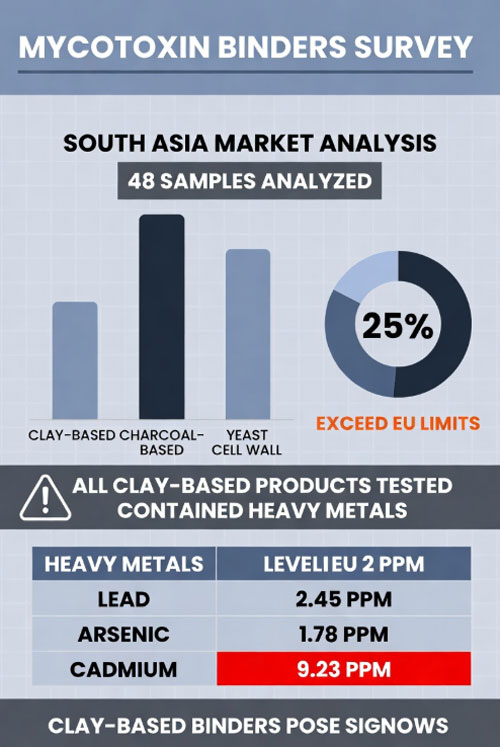
The issue isn’t just theoretical. A comprehensive 2015 survey conducted by Alltech across South Asia delivered sobering results. Analysing 48 samples of various mycotoxin binders, they found that every single clay-based product tested was contaminated with a mix of potentially toxic heavy metals: lead, arsenic, and cadmium.
Even more alarming, 25% of these samples were contaminated with at least one heavy metal above the European Union’s strict maximum permitted levels. In some extreme cases, cadmium was detected at up to 9.23 parts per million (ppm)—over four times the EU safety limit of 2 ppm.
This isn’t just a minor quality control issue; it’s a critical failure in safety that directly undermines the health and performance you’re working to protect.
How Do These Dangerous Contaminants Get There?
The pathway of contamination is rooted in the source and processing of the raw materials.
- The Mining Source: Not all clay deposits are created equal. Many natural deposits of clays like Hydrated Sodium Calcium Alumino-Silicate (HSCAS) are geologically co-located with veins of heavy metals. If the mine is not meticulously selected and the raw material not rigorously tested, these toxic elements are harvested right along with the binding clay.
- The Manufacturing Process: The risk doesn’t end at the mine. Some manufacturing processes use industrial dryers that operate at extremely high temperatures. This process can be a source of dioxin contamination. Furthermore, without stringent purification protocols, the heavy metals present in the raw clay are simply concentrated into the final product that ends up in your feed.
The Devastating Impact on Animal Health and Your Bottom Line
When contaminated binders are used, heavy metals like Lead (Pb), Cadmium (Cd), and Arsenic (As) are introduced directly into the animal’s digestive system. Unlike some organic toxins, these metals are not easily metabolized or excreted. Instead, they bioaccumulate—building up in tissues over time and leading to a cascade of health issues:
- Immune Suppression: Heavy metals are notorious for damaging the immune system, leaving animals more vulnerable to secondary infections and vaccines failing to achieve full efficacy.
- Organ Damage: The liver and kidneys, the body’s primary detoxification organs, are primary targets. As they work to filter these metals, they sustain cellular damage, impairing their function and the animal’s overall health.
- Residue Concerns: Perhaps most alarmingly, these metals can be deposited in meat, milk, and eggs, creating a food safety risk and potential regulatory violations that can devastate a brand’s reputation.
So, while you are diligently mitigating the known threat of mycotoxins, a substandard binder could be introducing a chronic, insidious threat that weakens animals from the inside out.
The Clentox®Bind Difference: Purity You Can Trust
At Specific Biosciences, we believe a solution should not create new problems. That’s why Clentox®Bind is engineered from the ground up with an uncompromising commitment to purity and safety.
Our rigorous protocol ensures that protection is never compromised by contamination:
- EU-Approved, Single-Source HSCAS: We source our HSCAS from a single, meticulously selected mine, guaranteeing not only superior binding efficacy but also consistent and verifiable purity, batch after batch.
- Sun-Drying Method: We reject high-temperature industrial dryers. Instead, our clay is sun-dried, a natural process that completely eliminates the risk of dioxin formation.
- Specialised Milling: Unique milling technique preserves the vital “platy” structure of the clay, which is essential for maximum mycotoxin adsorption, without introducing contaminants.
- Guaranteed 99% Minimum Purity: We don’t just hope for purity; we guarantee it. This ensures you are giving your animals a powerful toxin shield, free from harmful heavy metals.
Your Feed is Your Foundation. Protect It with a Foundation of Trust.
Don’t let a hidden threat sabotage your operation. When evaluating a mycotoxin binder, move beyond the datasheet on adsorption rates and ask the critical question: “Can you provide a certificate of analysis proving this product is free from heavy metal contamination?”
Choosing Clentox®Bind is a choice for proven science and guaranteed safety. It’s the confidence that you are neutralizing the threat of mycotoxins without introducing a new one. You’re not just binding toxins; you’re investing in the long-term health of your animals and the integrity of your products.
EU maximum levels for animal feed in ppm | ||||
Contaminant | Lead | Arsenic | Cadmium | Mercury |
Technological Additive | 30 | 25 | 2 | 1 |
Clentox®Bind values | <0.1* | <0.1* | <0.1* | <0.025* |
*LOQ: Limit of quantification | ||||
Pesticide Residue Clentox®Bind | |
Pesticide | Result |
Aldrin | <0.01* |
DDE | <0.01* |
DDT | <0.01* |
Dieldrin | <0.01* |
Endosulfan | <0.01* |
Lindane | <0.01* |
TDE | <0.01* |
*LOQ: Limit of Quantification | |
Protect your herd. Protect your investment. Choose a binder that puts purity first.