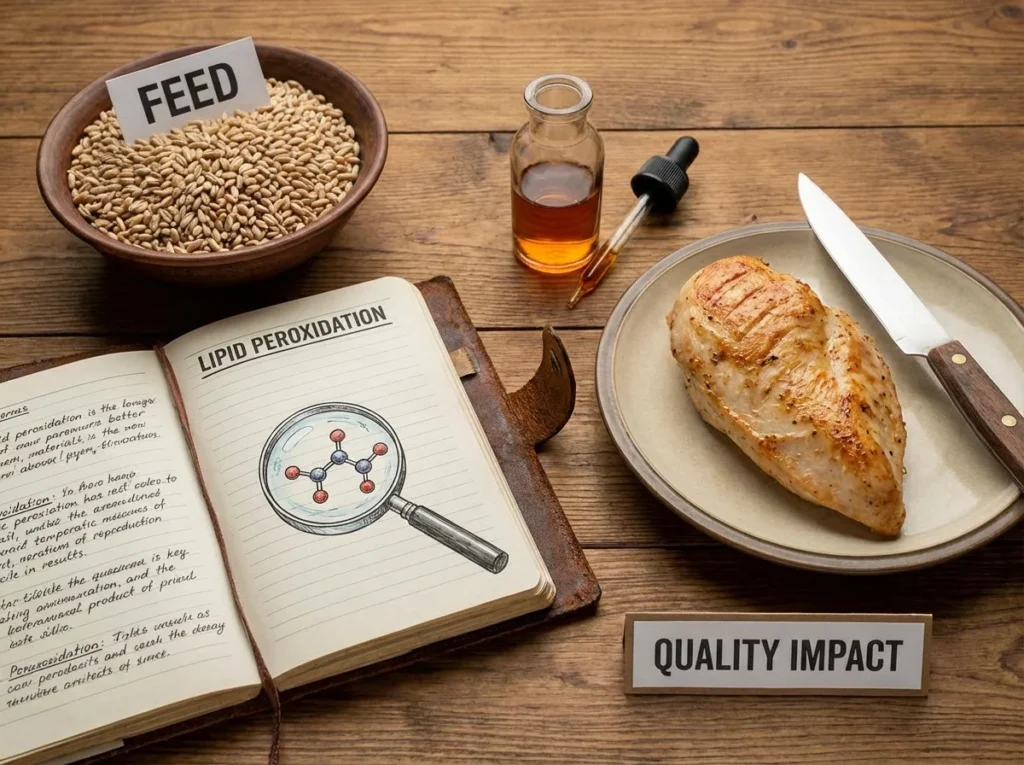
The pursuit of premium poultry meat quality is a battle fought at the cellular and molecular level. While genetics and nutrition lay the foundation for yield and growth, the final arbiter of sensory quality—color, flavor, and texture—is often oxidative stability. The primary antagonist in this context is lipid peroxidation, a free-radical chain reaction that degrades polyunsaturated fatty acids (PUFAs) within cellular membranes. This process directly undermines the structural and functional integrity of muscle and adipose tissue, leading to myopathies, off-flavors, and discoloration. A deep understanding of its mechanism is essential for developing effective mitigation strategies.
The Molecular Mechanism of Lipid Peroxidation
Lipid peroxidation is not a single event but a self-propagating cascade comprising three distinct phases: initiation, propagation, and termination.
1. Initiation
The process is initiated by reactive oxygen species (ROS) such as the hydroxyl radical (•OH), peroxyl radical (ROO•), or superoxide anion (O₂•⁻). These are generated endogenously as byproducts of cellular metabolism, particularly in the mitochondria of fast-growing birds with high metabolic rates. Exogenous factors like mycotoxins, heat stress, and dietary oxidized lipids further increase ROS load.
Initiation occurs when a ROS abstracts a hydrogen atom from a methylene group (-CH₂-) located between two double bonds in a PUFA (e.g., linoleic or arachidonic acid). This creates a lipid radical (L•).
RH (PUFA) + •OH → R• (lipid radical) + H₂O
2. Propagation
The lipid radical (L•) is highly unstable and rapidly reacts with molecular oxygen (O₂) to form a lipid peroxyl radical (LOO•).
R• + O₂ → ROO• (lipid peroxyl radical)
This peroxyl radical, in turn, can abstract a hydrogen atom from an adjacent PUFA, generating a lipid hydroperoxide (LOOH) and a new lipid radical, thus propagating the chain reaction.
ROO• + RH → ROOH (lipid hydroperoxide) + R•
This domino effect can continue for hundreds or thousands of cycles, causing extensive damage to cellular membranes.
3. Termination and Secondary Product Formation
The chain reaction is eventually terminated by the interaction of two radicals or, more critically, by the intervention of antioxidants. However, in a state of oxidative stress, the propagation phase dominates.
The primary product, lipid hydroperoxide (LOOH), is relatively stable but can decompose in the presence of metal ions (e.g., Fe²⁺ from heme proteins) via the Fenton reaction. This decomposition yields a complex mixture of reactive secondary products, including:
- Aldehydes: Malondialdehyde (MDA) and 4-Hydroxynonenal (4-HNE).
- Alkanes: Such as ethane and pentane.
These secondary products, particularly MDA and 4-HNE, are highly cytotoxic. They are known to form protein adducts, cross-link with amino acids, and disrupt essential cellular functions.
and profitability suffer.
The Pathophysiological Impact on Meat Quality
The consequences of this biochemical cascade are measurable and detrimental to the key sensory attributes of meat.
1. Color Degradation: Myoglobin Oxidation
The red color of meat is primarily determined by the redox state of myoglobin, with deoxymyoglobin (purple) and oxymyoglobin (bright red) being the desirable forms. Lipid peroxidation products, particularly peroxyl radicals and H₂O₂, act as potent pro-oxidants that accelerate the oxidation of ferrous iron (Fe²⁺) in oxymyoglobin to ferric iron (Fe³⁺), forming metmyoglobin. Metmyoglobin is responsible for the undesirable brownish-grey discoloration that consumers reject. The correlation between tissue MDA levels and metmyoglobin formation is well-established.
2. Flavor Deterioration: Warmed-Over Flavor (WOF)
The volatile secondary products of lipid peroxidation are the direct cause of off-flavors. Aldehydes like hexanal and 2,4-decadienal have low odor thresholds and impart the characteristic “rancid,” “painty,” or “warmed-over” flavors that render meat unpalatable. Sensory panel analyses consistently show a strong negative correlation between tissue TBARS (Thiobarbituric Acid Reactive Substances, a measure of MDA) and flavor acceptability scores.
3. Texture Defects: The Role in Myopathies
The link between lipid peroxidation and myopathies like Wooden Breast (WB) and White Striping (WS) is a focal point of contemporary research. The mechanism is pathophysiological:
- Membrane Permeabilization: Peroxidation of the phospholipid bilayer in the sarcolemma and sarcoplasmic reticulum increases membrane fluidity and permeability. This leads to a dysregulated influx of extracellular calcium (Ca²⁺).
- Calcium-Mediated Proteolysis: The elevated intracellular Ca²⁺ concentration prematurely and uncontrollably activates calcium-dependent proteases, notably calpains. This results in excessive degradation of myofibrillar proteins like titin and desmin, disrupting the Z-disc and myofibrillar integrity.
- Inflammation and Fibrosis: The cytotoxic aldehydes (4-HNE) act as signaling molecules, activating the NF-κB pathway and upregulating pro-inflammatory cytokines. This chronic, low-grade inflammation triggers a fibrotic response, with fibroblasts depositing excessive collagen (types I and III) within the perimysium and endomysium. This fibrosis manifests as the palpable hardness of WB and the visible striations of WS.
Mitigation Requires a Multi-Targeted Biochemical Approach
Given the multi-stage nature of lipid peroxidation, a single-pronged strategy is insufficient. An effective approach must intervene at multiple points in the pathway, which is the precise rationale behind the formulation of a product like Cynergy.
- Reducing the Peroxidation Substrate: Enhancing Fat Utilization
The first line of defense is to ensure dietary fats are efficiently utilized for energy production (beta-oxidation) rather than being incorporated into membranes where they are prone to peroxidation. Cynergy addresses this at the root:
- Optimized Emulsification: Its combination of bile acids and bio-surfactants ensures near-complete fat digestion and absorption. This is achieved through high HLB (Hydrophilic-Lipophilic Balance) values (16-19 for bile acids) that are optimal for micelle formation in the aqueous gut environment.
- Enhanced Beta-Oxidation: By providing L-carnitine and enzyme activators, Cynergy facilitates the transport of fatty acids into the mitochondria for energy production. This metabolic shunting reduces the pool of PUFAs available for peroxidation in cell membranes.
- Interruption of Propagation: Chain-Breaking Antioxidants
Cynergy incorporates a strategic blend of selected polyphenols and prebiotics that function as potent, chain-breaking antioxidants. These compounds donate electrons to stabilize lipid peroxyl radicals (LOO•), halting the destructive chain reaction within the cellular membrane itself. This action provides a direct Vitamin E sparing effect, conserving the bird’s endogenous antioxidant systems and significantly increasing the oxidative stability of muscle tissues. - Mitigating Secondary Damage: Supporting Hepatic Detoxification.
The liver is central to managing oxidative stress. The secondary bile acids and specific polyphenols in Cynergy support Phase I and II liver detoxification pathways. This enhances the bird’s capacity to neutralize and excrete lipid peroxidation end-products like MDA, as well as other pro-oxidants like mycotoxins, thereby reducing the systemic inflammatory load.
- Protecting Feed Integrity: Preventing Initiation at Source
The inclusion of natural feed antioxidants in the Cynergy matrix protects lipids within the feed from initial oxidation. This ensures that birds are not consuming pre-formed hydroperoxides, which would immediately increase the oxidative burden upon ingestion. - Scavenging of Secondary Products
While less common, strategies that involve the sequestration or neutralization of cytotoxic aldehydes like MDA and 4-HNE can help mitigate their damaging effects on proteins and cellular function.
Conclusion
Lipid peroxidation is not a superficial issue but a fundamental biochemical pathology that directly compromises the cellular integrity of poultry meat. Its role in the etiology of color defects, off-flavors, and particularly in the complex pathogenesis of Wooden Breast, is driven by defined molecular mechanisms involving radical chemistry, calcium dysregulation, and inflammatory signaling.
Therefore, safeguarding meat quality transcends simple antioxidant inclusion. It requires a sophisticated, evidence-based strategy designed to quench free radicals, stabilize cellular membranes, and interrupt the pro-inflammatory cascades that lead to fibrosis. By addressing lipid peroxidation at the biochemical level, producers can effectively protect the investment in their genetics and nutrition, ensuring that the scientific potential for premium quality is realized in the final product.