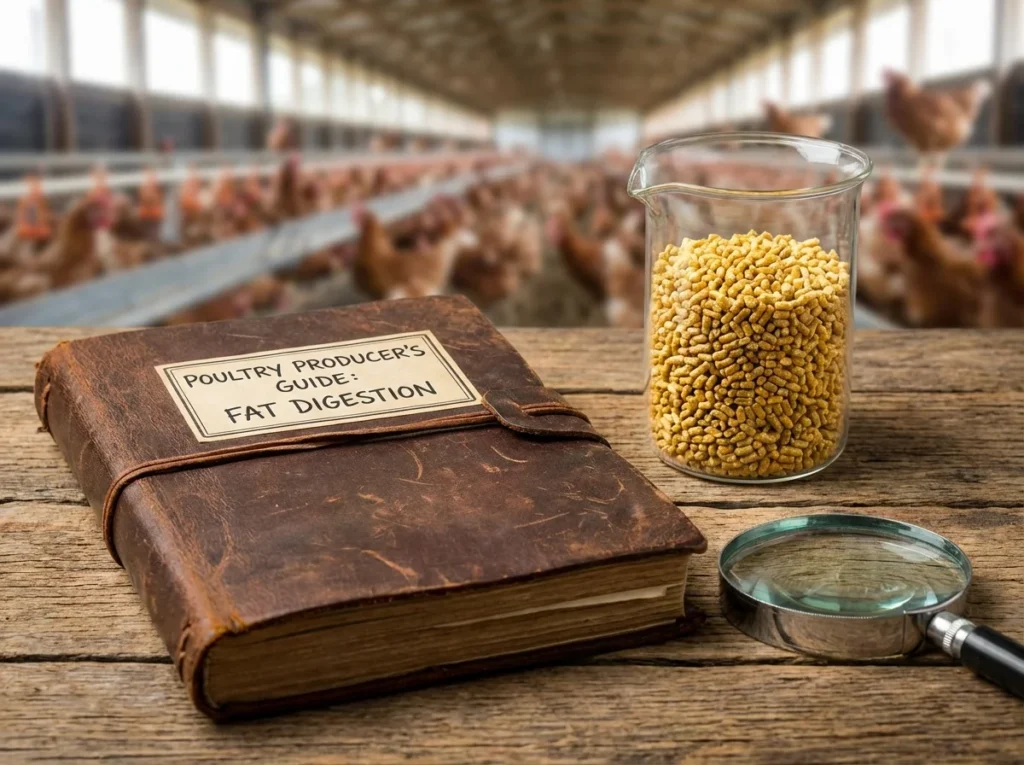
In the relentless pursuit of optimal feed conversion ratio (FCR) and cost-effective production, poultry nutritionists have long recognized fats as the most concentrated source of energy. Yet, a critical question often goes unasked: is the bird actually accessing all the energy we’re paying for?
The reality is that the journey from dietary fat to usable energy (ATP) is a complex, multi-stage process. Breaks in this chain can lead to significant “energy leaks,” leaving a substantial portion of that valuable fat to pass through the bird undigested or, worse, to cause metabolic havoc. Understanding this journey is the first step to plugging these leaks and unlocking the hidden energy potential within your feed.
The Fat Digestion Journey
Fat digestion is a physiological process involving emulsification, enzymatic breakdown, and cellular transport. When any part of this process fails, performance and profitability suffer.
Act 1: Emulsification – The Critical First Step
Imagine trying to wash a greasy pan with water alone. The fat simply globs together. The avian digestive tract is a water-based (aqueous) environment, and dietary fats are hydrophobic. They naturally separate into large, inaccessible globules.
This is where bile acids enter as the star performers. Produced by the liver and stored in the gallbladder, bile acids are biological detergents. They surround these fat globules, breaking them down into a fine emulsion of tiny droplets in a process called emulsification. This crucial step exponentially increases the surface area of the fat, making it accessible to the next key player: pancreatic lipase.
Where it goes wrong: Liver stress (from mycotoxins or fatty liver syndrome), disease, or the immature physiology of young chicks can lead to insufficient bile acid production or secretion. Without adequate bile, emulsification fails, and fat digestion plummets, leading to greasy droppings—a visible sign of wasted energy.
Act 2: Hydrolysis – The Enzymatic Breakdown
With the fat now emulsified into tiny droplets, pancreatic lipase, the primary fat-digesting enzyme, can get to work. Lipase hydrolyzes the triglycerides (the main component of fats) into smaller components: monoglycerides and free fatty acids.
The efficiency of this step is heavily dependent on the presence of conjugated bile acids (bile salts), which activate the enzyme and create the ideal environment for its action. Other factors like heat stress or pancreatic dysfunction can also impair lipase production and function.
Where it goes wrong: A deficiency in lipase, or conditions that inhibit its activity, results in incomplete fat breakdown. This means larger, undigested fat molecules remain in the gut, leading to feed passage, higher FCR, and lost energy value.
Act 3: Micelle Formation & Absorption
The products of hydrolysis—monoglycerides and free fatty acids—are still not ready for absorption. They need to be transported across the watery layer surrounding the intestinal cells (enterocytes). This is achieved through the formation of micelles.
Micelles are microscopic, shuttle-like structures formed by bile acids. They have a hydrophilic (water-loving) exterior and a hydrophobic (fat-loving) interior, which allows them to scoop up the digested fats and carry them to the intestinal wall for absorption. This step is also critical for the absorption of fat-soluble vitamins (A, D, E, and K).
Where it goes wrong: Certain dietary factors, particularly excess calcium or minerals, can bind to bile acids and disrupt micelle formation. This leads to direct malabsorption of fats and fat-soluble vitamins, causing deficiencies that impact immunity, bone health, and overall productivity, even if the fat was successfully broken down.
The Hidden Cost of Fat Digestion Failures
When this three-act process is disrupted, the consequences are both direct and indirect:
- Direct Energy Losses: Undigested fat in droppings represents a direct loss of costly dietary energy, often estimated at 10-30% lower energy uptake. This forces the bird to consume more feed to meet its energy needs, directly worsening FCR.
- Indirect Health & Performance Costs: Poorly digested fats can:
- Cause Gut Health Issues: They can alter the gut microbiota and irritate the intestinal lining.
- Promote Lipid Peroxidation: When fats, especially polyunsaturated fatty acids (PUFAs), are not properly utilized and become oxidized, they generate free radicals. This oxidative stress damages cell membranes, leading to conditions like fatty liver syndrome and myopathies like wooden breast.
- Deplete Vital Nutrients: The bird’s system must expend extra energy and antioxidants to deal with the fallout of poor fat digestion.
Plugging the Leaks: Optimizing the Fat Digestion Pipeline
Knowing where the process fails tells us exactly where to intervene. The key is to support the bird’s natural system, especially under modern high-performance pressures.
- Support Emulsification: Ensuring adequate bile acid activity is paramount. Supplementing with primary conjugated bile salts provides ready-to-use, highly effective emulsifiers that can immediately enhance fat digestion, particularly in young chicks or stressed birds whose endogenous production is lagging.
- Enhance Lipase Efficiency: Supporting pancreatic function and providing the necessary co-factors for enzyme activation ensures the hydrolysis step proceeds efficiently. In some cases, exogenous lipase can provide a direct boost.
- Protect Micelle Formation: Using well-balanced diets that minimize mineral interference protects the vital micelle-mediated transport system.
- Utilize Synergistic Blends: Modern solutions often combine different emulsifiers, such as bile acids and bio-surfactants. While bile acids excel in the small intestine, bio-surfactants can begin emulsification earlier in the gizzard and proventriculus, creating a synergistic effect that ensures fat is prepared for digestion throughout the entire tract.
Conclusion: From Cost to Investment
Dietary fat should be a powerhouse, not a problem. By viewing fat digestion not as a given, but as a complex chain of events that can be supported and optimized, producers can transform their fat inclusion from a mere cost into a strategic investment.
Unlocking the hidden energy in your feed isn’t about adding more fat; it’s about ensuring the fat you add is fully utilized. By strengthening the weakest links in the digestion chain—emulsification, hydrolysis, and absorption—you can directly improve FCR, enhance bird health and meat quality.